See the covenant breach before your bank does.
Upload your loan agreement and management accounts, or use a built-in sample. NorthStar forecasts every covenant test six quarters ahead.
Covenants are tested every quarter. Mid-sized companies learn of a breach after the quarter closes, when it's too late to fix.
Break a covenant and the bank can reprice the loan, charge a waiver fee or call it in. Large corporates pay for treasury teams and systems to see it coming. Mid-sized firms carry the same complex debt without either.
Mid-sized companies fall through the gap.
Simple debt
- Complex debt
- Small finance teams
- No budget for treasury systems
Treasury teams and expensive systems
Three files in. Six quarters of covenant tests out.
- 1
Your loan agreement
NorthStar finds the covenants, their limits and any step-downs, and quotes the clause each one came from.
- 2
Your management accounts
An Excel export with account names down the side. Lines are mapped to revenue, costs and debt, whatever your bookkeeper called them.
- 3
Your budget, if you have one
The forecast follows your budget for the quarters it covers, then your recent trend.
“Leverage in respect of any Relevant Period shall not exceed 3.25:1 for each Relevant Period ending on or before 30 September 2026 and 2.50:1 thereafter.”
The leverage clause from a sample agreement. Every covenant comes with the clause it was read from, so you can check it.
The language model never produces a number you see.
Open models read
An open-weight model finds the covenant section and extracts the terms. Only short excerpts are sent, never the whole agreement.
An engine calculates
Covenant tests, the forecast, headroom, stress tests and refinancing timing come from deterministic code you can audit.
Unchecked numbers are removed
Any written insight that quotes a number the engine did not produce is dropped. Chat answers that do so are flagged.
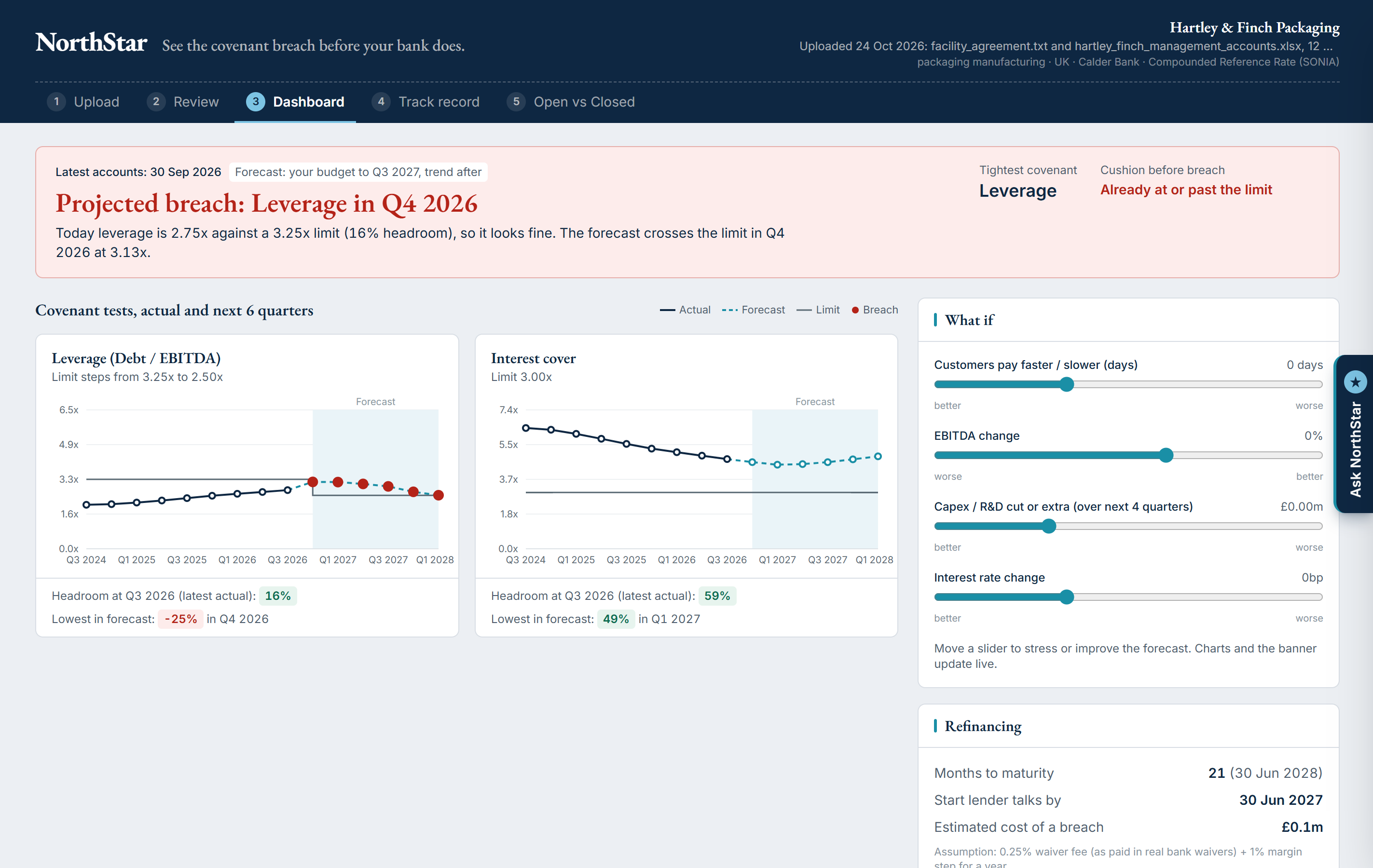
Drag the slider to see what faster collections do to the forecast.
Test a decision before you make it.
Move a slider and every covenant is recalculated: customers paying faster or slower, EBITDA up or down, capex cuts or extra spend, interest rate moves.
In the sample company, collecting from customers 25 days faster avoids the projected Q4 2026 breach.
Or ask in plain English
A real answer from the sample company. Answers run your scenarios through the same engine.
Replayed on a real company's filings.
Nortech Systems is a US electronics manufacturer with about $120m of revenue, one bank and no private equity owner. We fed NorthStar its SEC filings one quarter at a time and compared the forecast with what happened next.
Leverage against a 2.50x limit. 30% headroom, so it looked fine.
A breach, projected from the same filings.
Breached at the very next test, again in Q1 2025, then four covenant amendments in under two years.
Open models, deployable privately.
The reading is done by open-weight models. This demo runs them on a hosted service, but open weights mean a company could run the same models inside its own environment.
- Claude Opus 5.5ClosedCovenants read correctly16 / 16Cost per documentabout $0.0175 (estimate)
- DeepSeek V4.1 FlashOpenCovenants read correctly16 / 16Cost per document$0.0053
- MiniMax M3.1 FlashOpenCovenants read correctly16 / 16Cost per document$0.0006
| Model | Covenants read correctly | Cost per document |
|---|---|---|
| Claude Opus 5.5Closed | 16 / 16 | about $0.0175 (estimate) |
| DeepSeek V4.1 FlashOpen | 16 / 16 | $0.0053 |
| MiniMax M3.1 FlashOpen | 16 / 16 | $0.0006 |
Same prompt for every model: 16 covenants across 9 real SEC credit documents. Where open models fell short: on a messy redlined amendment, DeepSeek returned an empty answer twice, so redlined drafts still need a human check.
Check your next covenant test.
Upload your agreement and accounts, or start with a sample company. No account needed.